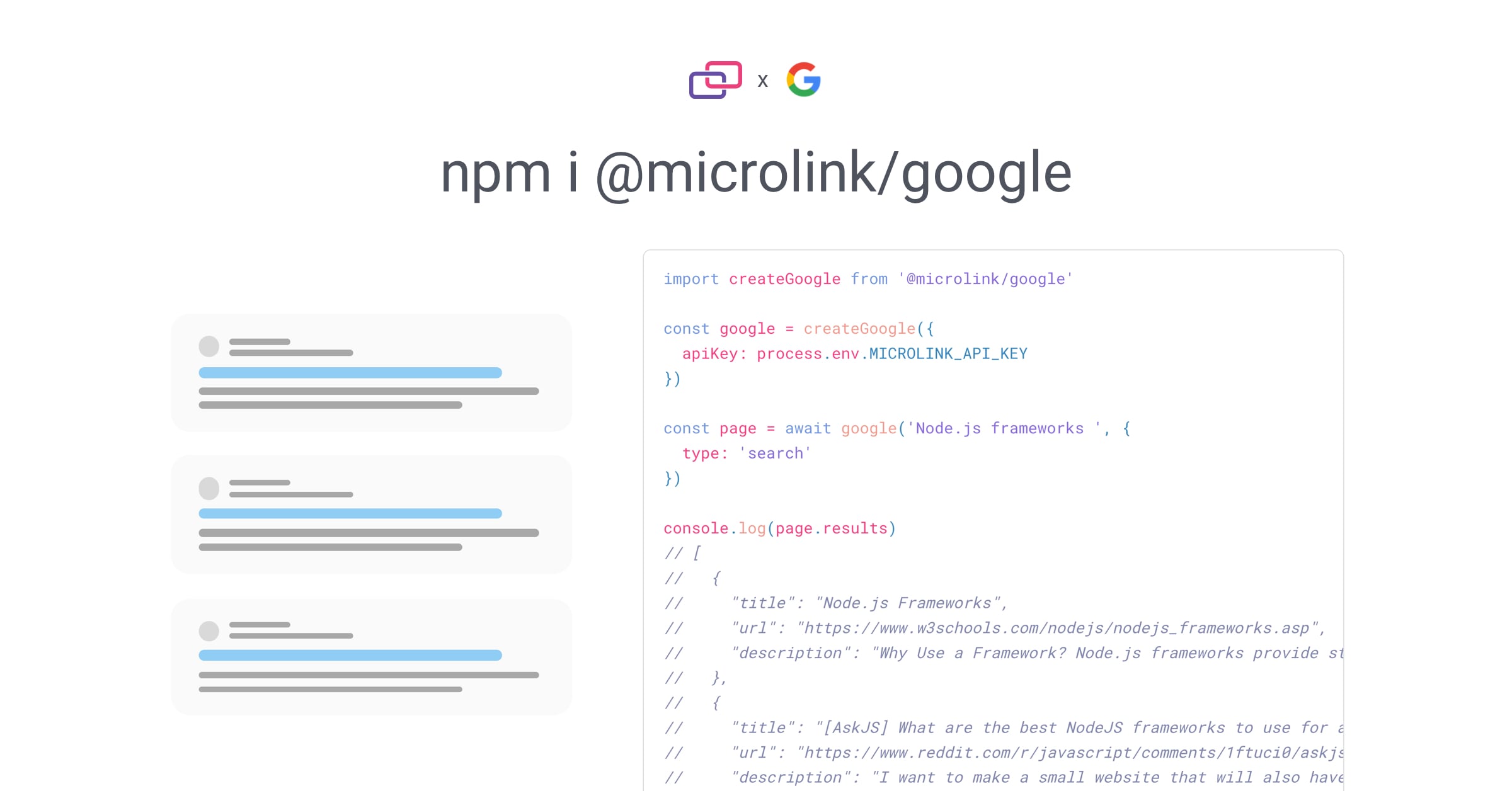



The @microlink/google library is a Node.js package that turns Google products such as Search, News, Images, Maps, Shopping, Scholar, and Autocomplete into structured API responses.
It is designed for developers building LLM tools, AI agents, research copilots, monitoring workflows, and products that need fresh Google data without parsing raw SERP HTML.
Additionally, the library supports serializing the content into HTML or Markdown in case you want to create your own parser.
@microlink/google is designed for products that need fresh Google data in a format LLMs can reliably consume.
-
Search augmentation for agents
Give agents access to structured Google results instead of forcing them to parse raw SERP markup. -
RAG and retrieval pipelines
Pull live Search, News, Scholar, Shopping, or Maps data into retrieval workflows, then fetch full page HTML only when needed. -
Research copilots
Build assistants that can compare sources, inspect pagination, expand related searches, and gather context across multiple Google verticals. -
LLM-friendly schemas
Consistent fields such astitle,url,description,price,rating,coordinates, and image metadata reduce prompt complexity and post-processing.
-
Google Search API for AI agents
Give tool-calling systems a reliable way to search the live web and return structured result objects. -
Google News API for assistants
Monitor recent developments, fetch publishers and dates, and summarize fresh stories inside AI workflows. -
Google Scholar API for research copilots
Retrieve papers, citations, and academic sources for technical or scientific research tasks. -
Google Maps and Places API for entity lookup
Resolve businesses, addresses, phone numbers, coordinates, ratings, and local context.
Install the package from npm and use it anywhere you need structured Google data in a Node.js workflow.
npm install @microlink/googleStart with a minimal query, inspect the structured response, and then expand into HTML fetches or pagination only when needed.
The only prerequisite to initialize @microlink/google is to have Microlink API key:
const google = require('@microlink/google')({
  apiKey: process.env.MICROLINK_API_KEY
})
Make your first query:
const page = await google('Lotus Elise S2')

console.log(page.results)
// [
//   {
//     title: 'Lotus Elise - Wikipedia',
//     url: 'https://en.wikipedia.org/wiki/Lotus_Elise',
//     description: 'The Lotus Elise is a two-seat, rear-wheel-drive...'
//   }
// ]
Use Google search operators to refine queries:
const page = await google('Lotus Elise S2 filetype:pdf')Localize results using location or filter by time with period:
await google('recetas de pasta', {
  location: 'es',
  period: 'week'
})A typical search response is easy to pass into an LLM tool result:
const page = await google('typescript runtime')

console.log({
  type: page.type,
  total: page.results.length,
  results: page.results.slice(0, 2)
})
This usually gives you a compact object containing entries like:
{
  title: 'TypeScript: Documentation',
  url: 'https://www.typescriptlang.org/docs/',
  description: 'TypeScript extends JavaScript by adding types...'
}Any result containing a url exposes lazy .html() and .markdown() methods:
const { results } = await google('node.js frameworks')

for (const result of results) {
  console.log(await result.html())
  console.log(await result.markdown())
}Pages chain naturally:
const page1 = await google('node.js frameworks')
const page2 = await page1.next()
const page3 = await page2.next()
You can also iterate:
let page = await google('node.js frameworks')

while (page) {
  for (const result of page.results) {
    console.log(result.title)
  }

  page = await page.next()
}Expose google(query, options) as a tool and let the model choose:
- when to use Search vs News vs Scholar
- when to request the next page
- when to expand a result with
.html()or.markdown()
A common pattern looks like:
- search for the topic
- inspect the top results
- fetch HTML for the most promising sources
- summarize or compare the sources
- paginate if confidence is still low
Instead of one generic search tool, route intent by task:
search: general web retrievalnews: recent developmentsscholar: papers and citationsshopping: product comparisonsplaces/maps: local business contextautocomplete: query expansion and prompt suggestion
Use Autocomplete and related searches to improve retrieval coverage:
const page = await google('how to fine tune', { type: 'autocomplete' })
console.log(page.results)- Structured outputs by default: easier prompting, fewer parsing failures
- Type-aware fields: prices, ratings, coordinates, and images are normalized
- Composable depth: lightweight result first, HTML second
- Cross-vertical coverage: one package for multiple Google surfaces
- Tool ergonomics: simple
google(query, options)interface for agent frameworks
Use the lookup below to match each Google vertical with the kind of workflow it supports best.
| Type | Product | Best for | Example |
|---|---|---|---|
search |
Google Search | General web retrieval, brand lookup, related questions | google('Lotus Elise S2') |
news |
Google News | Recent developments, launches, incidents, market changes | google('artificial intelligence', { type: 'news' }) |
images |
Google Images | Visual references, image metadata, asset discovery | google('northern lights', { type: 'images' }) |
videos |
Google Videos | Tutorials, content research, video SERP coverage | google('cooking tutorial', { type: 'videos' }) |
places |
Google Places | Local entities, addresses, phone numbers, coordinates | google('coffee shops denver', { type: 'places' }) |
maps |
Google Maps | Rich place metadata, ratings, hours, pricing | google('apple store new york', { type: 'maps' }) |
shopping |
Google Shopping | Product intelligence, prices, merchant comparisons | google('macbook pro', { type: 'shopping' }) |
scholar |
Google Scholar | Academic and technical research workflows | google('transformer architecture', { type: 'scholar' }) |
patents |
Google Patents | Prior-art, invention, and filing research | google('touchscreen gestures apple', { type: 'patents' }) |
autocomplete |
Google Autocomplete | Query expansion, intent mining, UX suggestions | google('how to', { type: 'autocomplete' }) |
Choose a workflow below to jump straight to the tutorial:
-
Agentic search
Use Google Search as a tool for assistants that need current sources and structured result objects. -
Source expansion for RAG
Start with lightweight search results, then fetch full HTML only for the sources worth indexing or summarizing. -
Live news monitoring for assistants
Pull current Google News results into monitoring, summarization, and alerting workflows. -
Entity and local lookup
Use Places and Maps for local business context, coordinates, contact data, and place metadata.
Use Google Search as a tool in an agent loop:
const google = require('@microlink/google')({
  apiKey: process.env.MICROLINK_API_KEY
})

const page = await google('best vector databases for rag')

return page.results.map(result => ({
  title: result.title,
  url: result.url,
  summary: result.description
}))Start with Search, then fetch page HTML only for the most relevant sources:
const page = await google('site:openai.com function calling guide')

const topSources = await Promise.all(
  page.results.slice(0, 3).map(async result => ({
    title: result.title,
    url: result.url,
    html: await result.html()
  }))
)Use Google News to give assistants current event context:
const page = await google('open source llm', { type: 'news' })

console.log(page.results.map(({ title, date, source }) => ({
  title,
  date,
  source
})))Use Places and Maps when your assistant needs business or location context:
const page = await google('coffee shops denver', { type: 'places' })

console.log(page.results[0])
// {
//   title,
//   address,
//   phone,
//   coordinates: { latitude, longitude }
// }Use Google Search when you need broad web retrieval with related questions, knowledge graph context, and query expansion.
Web results with knowledge graph, related questions, and related searches.
const page = await google('Lotus Elise S2')

page.results[0]

page.knowledgeGraph
page.peopleAlsoAsk
page.relatedSearchesUse Google News when freshness matters and your workflow depends on publishers, dates, and recent developments.
Recent articles with publisher, date, and thumbnail.
const page = await google('artificial intelligence', { type: 'news' })Use Google Images when you need image URLs, dimensions, and visual search results as structured data.
Full-resolution image URLs with dimensions.
const page = await google('northern lights', { type: 'images' })Use Google Videos when your workflow needs video discovery, metadata, and duration-aware results.
Video metadata with duration in milliseconds.
const page = await google('cooking tutorial', { type: 'videos' })Use Google Places for local entity lookup, contact data, and coordinates.
Local business listings with coordinates and contact info.
const page = await google('coffee shops denver', { type: 'places' })Use Google Maps when you need richer place metadata such as ratings, opening hours, and pricing.
Detailed place data with ratings, hours, and pricing.
const page = await google('apple store new york', { type: 'maps' })Use Google Shopping for product intelligence, merchant comparison, and structured price data.
Product listings with parsed prices and structured ratings.
const page = await google('macbook pro', { type: 'shopping' })Use Google Scholar for academic research workflows that need papers, citations, and publication context.
Academic papers with citation counts and PDF links.
const page = await google('transformer architecture', { type: 'scholar' })Use Google Patents for invention research, prior-art analysis, and filing lookup.
Patent filings with ISO 8601 dates and metadata.
const page = await google('touchscreen gestures apple', { type: 'patents' })Use Google Autocomplete to expand queries, discover intent, and seed retrieval prompts.
Search suggestions as you type.
const page = await google('how to', { type: 'autocomplete' })These are the most common questions developers and AI teams ask before integrating @microlink/google.
No. It works for any product that needs structured Google data. But it is especially useful for agent workflows, retrieval pipelines, and AI products that benefit from normalized output.
You can, but raw markup is harder to maintain, harder for LLM tools to consume, and usually requires much more custom parsing logic.
Yes. The interface is simple enough to wrap in tool definitions for agent frameworks, copilots, and orchestration systems.
Yes. Use .next() for pagination and .html() or .markdown() on any result with a url when you need full page markup.
The API surface is intentionally small: one main function, a few routing options, and lazy helpers for deeper retrieval.
Required
Type: string
The search query. Supports Google search operators.
await google('annual report filetype:pdf')
await google('security updates site:github.com')
await google('"machine learning" site:arxiv.org')Options let you choose the Google vertical, localize results, and constrain freshness.
Type: string
Default: 'search'
Values: 'search' | 'news' | 'images' | 'videos' | 'places' | 'maps' | 'shopping' | 'scholar' | 'patents' | 'autocomplete'
Selects which Google product to query.
await google('artificial intelligence', { type: 'news' })Type: string
Default: 'us'
Values: Location
Controls result geolocation using a country code (ISO 3166-1 alpha-2). This influences ranking, language, and local intent.
await google('recetas de pasta', { location: 'es' })Type: string
Default: undefined
Values: 'hour' | 'day' | 'week' | 'month' | 'year'
Limits results to a recent time window. Useful for news monitoring and freshness-sensitive queries.
await google('tech news', { period: 'week' })This library interacts with publicly available Google services and normalizes the resulting data.
It is not affiliated with, endorsed by, or sponsored by Google.
Use of this library must comply with Google’s Terms of Service, applicable laws, and any relevant data usage policies.
Users are responsible for their use of this library and any data obtained through it.
microlink/google © Microlink, released under the MIT License.
Authored and maintained by Kiko Beats with help from contributors.
microlink.io · GitHub microlinkhq · X @microlinkhq