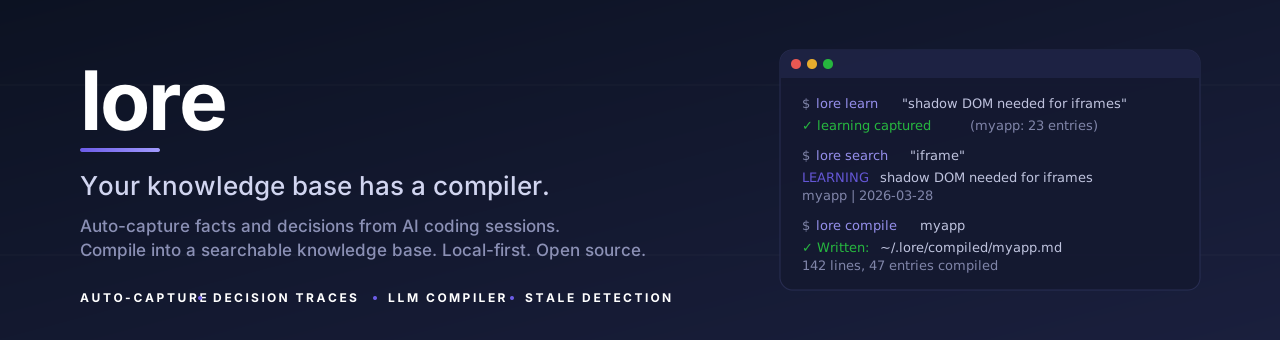
The open-source knowledge compiler for AI coding sessions.






pip install lore-kb
lore init && lore demo
lore search "adapter"
lore compile demo && cat ~/.lore/compiled/demo.md
Captures six sample entries, searches across them, and compiles them into a CLAUDE.md-compatible article in under a minute.
Status: v0.1.0 alpha — first public release (2026-04-23). See releases for changelog. Feedback welcome via issues.
Every AI coding session generates knowledge. Today, 99% of it is thrown away.
- You spend 2 hours figuring out a tricky workaround. Close the terminal. Gone.
- Three weeks later, same problem, new session. Claude has no memory. You re-discover it.
- You maintain CLAUDE.md files by hand — but who actually updates them?
- You keep terminal windows open for a week because closing them loses context.
"Each session is now 1M token context. You keep prompting and developing for hours, sometimes days. Having this searchable would be the real magic." — early user, 2026-04
lore captures knowledge from your AI coding sessions — facts, decisions, learnings — and compiles them into a searchable, version-controlled knowledge base. It works two ways: automatically via an MCP server that Claude Code calls during conversation (zero friction), or manually via CLI when you want to capture something explicitly. Knowledge persists across sessions, is searchable, and compiles into clean CLAUDE.md-compatible articles.
You work. lore remembers.
Current workarounds are all manual and fragile: custom /learn commands, copy-pasting chats, sending agents to re-read entire repos, Obsidian + MCP, session hooks. Everyone is building the same hacky solution independently. lore replaces all of that with one tool.
| Auto-capture | Stores WHY | Compiles articles | Stale detection | Local-first | CLI-first | |
|---|---|---|---|---|---|---|
| Obsidian | ✗ | ✗ | ✗ | ✗ | ✓ | ✗ |
| Notion AI | ✗ | ✗ | partial | ✗ | ✗ | ✗ |
| Fabric | ✗ | ✗ | one-shot | ✗ | ✓ | ✓ |
| Khoj | ✗ | ✗ | ✗ | ✗ | hybrid | ✗ |
| Rewind | ✓ (screen) | ✗ | partial | ✗ | partial | ✗ |
| CLAUDE.md | ✗ | ✗ | ✗ | ✗ | ✓ | ✗ |
| lore | ✓ (MCP) | ✓ | ✓ | ✓ | ✓ | ✓ |
The gap: every tool either requires manual capture (which people skip) or captures everything without structure (which is noise). Nothing automatically captures structured knowledge from AI coding sessions and compiles it into something useful.
- Auto-capture via MCP — Claude Code calls lore during conversation. You never type
loreanything. Knowledge flows in as a side effect of working. - Decision traces — not just what you decided, but why, what you tried first, why it failed, and what happened after. Six months later, the full context is still there.
- LLM compiler — takes 50 raw entries and produces one 150-line article. CLAUDE.md-compatible. Under the 200-line budget power users maintain. Auto-generated.
- Cross-session search — structured search that knows types (fact vs decision vs learning), projects, time, and outcomes. Not grep — intelligence.
- Stale detection — facts expire after 30 days by default.
lore statusflags what needs re-verification. No more acting on outdated information. - Local-first — JSONL files on disk. No database. No cloud. No telemetry. No phone-home. Git-friendly. Your knowledge stays on your machine.
┌─────────────────────────────────────────────────────────────┐
│                     YOUR WORK SESSION                       │
│                                                             │
│  You ↔ Claude Code (normal conversation)                    │
│         │                                                   │
│         ├─ detects a fact ──────→ lore_capture (automatic)  │
│         ├─ makes a decision ───→ lore_capture (automatic)   │
│         └─ receives feedback ──→ lore_capture (automatic)   │
│                                                             │
└──────────────────────────┬──────────────────────────────────┘
                           │
                    ┌──────▼──────┐
                    │  ~/.lore/   │
                    │  entries/   │  JSONL (append-only, git-friendly)
                    │  *.jsonl    │
                    └──────┬──────┘
                           │
                     lore compile
                           │
                    ┌──────▼──────┐
                    │  compiled/  │
                    │  project.md │  CLAUDE.md-compatible article
                    └─────────────┘
{
  "type": "decision",
  "content": "Use Redis for sessions",
  "why": "PostgreSQL advisory locks deadlocked under load",
  "tried_first": "pg_advisory_lock with retry loop",
  "failed_because": "Deadlocks at >50 concurrent connections",
  "outcome": "Redis handles 10x the load, no deadlocks"
}
Not just what — but why, what was tried first, why it failed, and what happened. This is a decision trace. When future-you asks "why don't we use PostgreSQL for sessions?" the answer is already there.
# api

## Key Decisions
- **Use Redis for sessions**
  - Why: PostgreSQL advisory locks deadlocked under load
  - Outcome: Redis handles 10x the load, no deadlocks

## Known Pitfalls
- pg_advisory_lock deadlocks at >50 concurrent connections

## Current State
- API rate limit is 100 req/min per key

## Rules
- Always run tests before committing
Under 200 lines. Only the relevant stuff. Stale facts excluded. The AI reads this at the start of every session.
pip install lore-kbPython 3.10+. Optional: set ANTHROPIC_API_KEY for LLM-powered compilation (without it, lore compiles offline using structured templates).
# A learning you want to remember
lore learn "iframe automation requires shadow DOM inspection" -p myproject

# A decision with full reasoning
lore decision "Use Redis for sessions" -p api \
  --why "PostgreSQL advisory locks deadlocked under load" \
  --tried-first "pg_advisory_lock with retry loop" \
  --failed-because "Deadlocks at >50 concurrent connections" \
  --outcome "Redis handles 10x the load, no deadlocks"

# A fact (auto-expires in 30 days)
lore fact "API rate limit is 100 req/min per key" -p backend

# A rule (applies across all projects)
lore feedback "Always run tests before committing"lore search "rate limit"
lore search --type decision --project api
lore search "iframe"lore compile myproject
# → ~/.lore/compiled/myproject.md (142 lines, CLAUDE.md-compatible)lore ships as an MCP server. After setup, Claude captures knowledge automatically during every conversation.
lore installThis prints the config to add to your Claude Code settings. After that, Claude has three tools:
| MCP Tool | What Claude does with it |
|---|---|
lore_capture |
Stores a fact, decision, learning, or feedback proactively during conversation |
lore_search |
Finds relevant knowledge from past sessions when context is needed |
lore_context |
Loads the compiled project summary at the start of a conversation |
You never type anything. Claude calls these tools as a side effect of working with you.
| Command | What it does |
|---|---|
lore init |
Set up ~/.lore/ directory |
lore demo |
Generate sample entries to try it out |
lore learn "..." |
Capture a reusable learning |
lore fact "..." |
Capture a fact (auto-expires in 30 days) |
lore decision "..." --why "..." |
Capture a decision with full reasoning trace |
lore feedback "..." |
Capture a rule or preference (applies globally) |
lore ref "..." |
Capture a reference to external info |
lore search "query" |
Search across all captured knowledge |
lore compile <project> |
Synthesize entries into a CLAUDE.md-compatible article |
lore status |
See what's captured, what's stale |
lore serve |
Start the MCP server (for Claude Code auto-capture) |
lore install |
Print Claude Code integration instructions |
~/.lore/
├── entries/              # Raw captures (JSONL, append-only)
│   ├── myapp.jsonl       # One file per project
│   ├── backend.jsonl
│   └── _global.jsonl     # Feedback and preferences
└── compiled/             # LLM-synthesized articles
    ├── myapp.md          # Auto-generated, CLAUDE.md-compatible
    └── backend.md
- JSONL — one JSON object per line.
grep,jq,git diffall work. - Git-friendly — commit
~/.lore/. Your knowledge is version-controlled. - No database — just files. Move them, back them up, sync them. Zero lock-in.
Already have Obsidian, a wiki, CLAUDE.md files, or a custom KB? lore doesn't replace any of that. It sits underneath as the capture + compilation engine.
Layer 1: lore entries        ← raw facts/decisions (captured automatically)
                ↓
Layer 2: compiled summary    ← LLM-synthesized, ~150 lines (AI reads this)
                ↓
Layer 3: your full articles  ← human-maintained, has the story + context (you read this)
Layer 2 doesn't replace Layer 3. The compiled summary is what the AI reads at session start — concise, current, actionable. Your full articles keep the narrative: why decisions were made, what was tried, the chronological story of how a project evolved.
| Before lore | With lore | |
|---|---|---|
| Capture | Stop working, open notes, write something | Automatic — lore captures during conversation |
| AI context | You maintain CLAUDE.md by hand | lore compiles a summary the AI reads automatically |
| Your articles | You manually update everything | Lighter updates — just add new narrative. lore handles the summary. |
| Search | Open Obsidian, Cmd+F, browse pages | lore search "query" — instant, cross-project, structured |
| Staleness | Nobody knows if old notes are still accurate | lore status flags facts older than 30 days |
- Your Obsidian vault — lore's compiled markdown works as an Obsidian vault. Open
~/.lore/compiled/alongside your existing vault. - Your full articles — session notes, decision narratives, historical context stay yours. lore supplements, not supplants.
- Your domain knowledge — concepts, frameworks, reference material that isn't project-specific. lore is for project knowledge, not encyclopedias.
- Your raw source docs — PDFs, screenshots, email threads. lore captures from conversations, not files.
lore is early and we need help with:
- MCP integrations — Cursor, Codex, OpenCode support
- Compile patterns — custom templates for different article styles
- Offline compilation — better structured templates without LLM
- Testing — more edge-case coverage
- Docs — tutorials, blog posts, translations
See CONTRIBUTING.md and the issues for specific tasks.
Apache License 2.0 — free for any use, including commercial. No telemetry. No phone-home. Your knowledge stays on your machine.
Built by Swathi because she kept closing terminals and losing a week's context.
Star on GitHub · pip install lore-kb · Issues