Computer science: Add new graphs project#29037
Computer science: Add new graphs project#29037damon314159 wants to merge 2 commits intoTheOdinProject:mainfrom
Conversation


 damon314159
force-pushed
the
new-project-graphs
branch
from
damon314159
force-pushed
the
new-project-graphs
branch
from
9f0364e to
839247a
Compare
 wise-king-sullyman
requested review from
a team and
CouchofTomato
and removed request for
a team
wise-king-sullyman
requested review from
a team and
CouchofTomato
and removed request for
a team

|
@damon314159 Thanks for making this PR! My initial impression of this is good. I did wonder why you ask for an adjacency matrix over an adjacency list? A list would be more convenient (or equivalently convenient) for nearly every operation, and I suspect learners who've been formally exposed to this will bring that up. |

It wasn't a decision I put a lot of weight on. I mostly went with a matrix so that it was easily displayable. I don't object to switching to a list approach, but it does increase the complexity of the visualisation |
|
Visualization is a good point, and I think some of the inconveniences with adding and removing vertices and edges make for good practice with keeping state held between multiple structures in-sync. I could probably be onboard for a matrix, but I think it could be good to potentially talk a bit more about a list and maybe recommend using that in Knight Travails? |
|
Sorry I left this hanging for so long! I completely forgot about it. |

|
Sorry for taking a bit to look back at this @damon314159 I'm still potentially interested in including this, but I want to discuss some things with the team first. I'm a bit wary on the scope of the project gauntlet of Linked List > Hash Map > Binary Search Tree > Knight Travails, and this will be another project to add to that bit. But I also think expanding the quality of the graph instruction would be nice for helping with Knight Travails and giving learners a better foundation in that area. I'll get back to you after I've discussed more. |
|
Okay gonna shift my above concerns to another issue and begin reviewing this in earnest this week because I think it's a good idea. Thank you for your patience 🙌 |

 JoshDevHub
left a comment
JoshDevHub
left a comment
JoshDevHub
left a comment
There was a problem hiding this comment.
This is really good I think. One of the main things to figure out would be the image. Let me know if you have any questions about that.
I think the content all makes really good sense here. I might get another, less DSA-oriented maintainer to look this over and see if it's clear from that perspective.
I'll also try to put together a solution myself over the weekend and see how it feels.
Let me know if you have any other comments/concerns @damon314159
| - In a road map, cities are vertices, and roads between them are edges | ||
| - In a computer network, devices are vertices, and connections between computers are edges | ||
|
|
||
|  |
There was a problem hiding this comment.
Feel free to draw up a concrete example here. Should be able to just throw together something simple using excalidraw.
You can find out how to add images to the curriculum through the contributing guide.
There was a problem hiding this comment.
Will get something worked out this evening


|
Hi, great work @damon314159 . Although I am not involved with this PR in any way, I was looking at it and just wanted to offer my perspective on some things I noticed. In particular, neither the project description nor the G4G article explains why one might use an adjacency list vs an adjacency matrix, and in the case of the matrix, why it is even useful to represent a graph as a matrix in the first place. This latter point about matrices also has implications regarding And moreover, unless learners have had exposure to matrices before (via calculus/linear algebra course), you can't really appreciate all the nice things that matrices can tell you about the underlying data. This is all to say that I think adjacency lists are a much more motivating representation, as one wouldn't need an intuition about matrices to actually reason about their usefulness and applicability. |
|
@scriabin-enjoyer do you have an idea how we could do some kind of visualisation for that? While not necessary I think it adds a layer of tangibility that many learners will appreciate if there is some kind of visual |
|
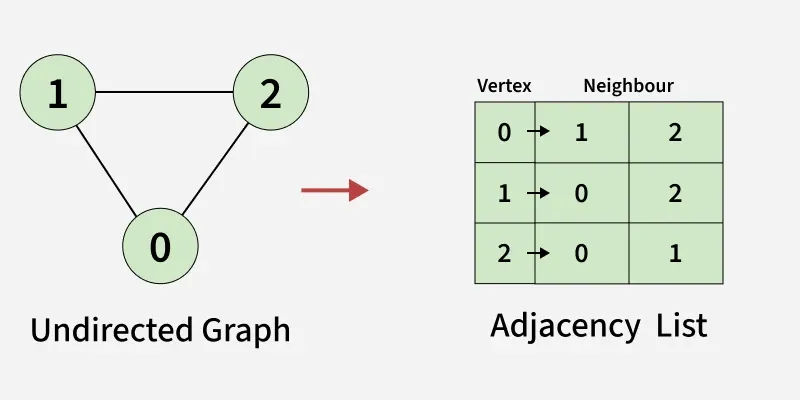
@damon314159 Yeah there are several options. The G4G article linked does provide a graphical representation see here. Typically (in my experience) people usually represent adjacency lists as associative arrays with the keys being the nodes of the graph and the values are arrays or linked lists containing nodes that are adjacent to the key. Such a textual representation would be imo a legitimate replacement for the 
Edit: Additionally, here is a re-work of your function printAdjacencyList(graph) {
for (const vertex in graph.adjList) {
const neighbours = graph.adjList[vertex].map(v => `( ${v} )`).join(' -> ')
console.log(`${vertex}: ` + neighbours);
}
}It's especially nice for directed graphs. It will print something like the following (for an undirected mesh topology with 3 vertices): |

|
After thinking about this some more, I also think an adjacency list would be the better approach to show. We can figure something out for generating a nice visual (something to similar to what @scriabin-enjoyer posted seems fine enough to me) I think the matrix representation is a bit more difficult to reason through for someone new to graphs and without any prior math or CS experience around such concepts. It also very much simplifies things like adding new vertices or adding new neighbors and so on. I think the matrix representation is cool in the sense that you have to keep multiple structures in-sync, but I've become drawn to the specter of simplicity regarding the DSA topics over time. Especially since I'm one of the main people maintaining it and dealing with people's problems and issues 😅 If you feel strongly it should be a matrix though, we could talk about it some. I almost feel like if we go that route, we may want a graph lesson that goes more into it, adjacency lists, and the situations where a developer may use one vs. the other. Anyways, let me know what you think @damon314159 |
|
Basically everything else about this is good to go I think. So if we can figure this bit out, I think this could come together and be pushed into the curriculum pretty soon. |
|
Any further input for this @damon314159 ? No rush or anything, just curious where you're at re: my last messages. Another thing that might be of interest is this #30512 TLDR: we plan to move the testing sections ahead of the CS section and then require learners to test the projects in the CS section. Should this project be accepted, I'd want to do the same with it. This should make it less of a requirement to have a pretty console output of the graph, as learners would be expected to test their implementation rather than manually running operations and checking stdout. But yeah. Let me know what you think. |


|
Hi @JoshDevHub maybe this is something @scriabin-enjoyer can take over from me if they're willing? Not sure I've got capacity to make the changes and/or add tests as it stands. I recognise this project has been collecting dust for a while now |
|
@damon314159 Thanks for letting me know. And of course thank you for all the work you've put into this so far and for having the idea in the first place. @scriabin-enjoyer Would you want to take ownership of this PR from here? If not, that's perfectly fine, and I can probably even take it myself. Just checking if you have any interest. |
|
Hi @JoshDevHub , Yeah I can take this on. A few questions:
@damon314159 thanks very much for all the work you've done already, I think you've done all the hard parts of it so getting this merged shouldn't be too painful (...i think lol). I would value any insight you have going forward if you notice anything important to share. |
|
Thank you for agreeing to pick this up @scriabin-enjoyer
I'll think more about this as it gets closer to merging. If we already have the other stuff done or mostly done, it may make sense to go ahead and remove the "Test your Graph" thing and add a little information about writing automated tests for this project. If the other stuff isn't close to being done though and this becomes ready to merge, we can leave that section alone. So for a direct answer: just leave that section in for now.
I think a computer network is a good illustration.
This sounds correct. Note that we can accept and fully merge the first two PRs without any effects on the site (and we probably will do just that). Also note that you can add (and should) add the image files to this PR. The PR for the image should just be to replace direct links to the images in the lesson content with CDN links (better performance around the world). You can see more about that here (it says you need two PRs, but you can just include the image files with this one and that's fine).
I like the |
|
Superseding this with #30700 |
3 participants


Because
The concept of graphs is introduced but rather swept under the rug in the current implementation of the knight travails project
This PR
Issue
Closes #28487
Additional Information
Notes:
Pull Request Requirements
location of change: brief description of changeformat, e.g.Intro to HTML and CSS lesson: Fix link textBecausesection summarizes the reason for this PRThis PRsection has a bullet point list describing the changes in this PRIssuesection